
Camera selection
Fisheye or multi-sensor: choosing by what the view has to prove
Both cover a lot of space from one mounting point, which is why both get sold on the same promise: one camera instead of four. That is the wrong reason to choose either. They fail differently, and which failure you can live with is a property of the room, not of the camera.
The short answer
One sensor behind a wide lens, or several heads on one mount
A fisheye is one sensor behind a very wide lens. It produces a single continuous image of everything below and around it, which software then straightens into views a person can read. There are no seams in it and nothing to aim: it sees what it sees, and where you look within that is decided afterwards, in software, including afterwards on a recording.
A multi-sensor camera is several separate camera heads in one housing, on one mount, sharing one cable run. Each head looks at its own part of the scene. The images sit alongside each other rather than forming one picture, and each head can be aimed at something in particular.
Almost everything that follows comes from that structural difference. The fisheye distributes whatever it has evenly across everything it can see. The multi-sensor lets you decide where its capability goes, and requires somebody to decide.
Neither is an upgrade of the other, and we are not going to rank them. They are two answers to the same question that are wrong in opposite directions, which is a genuinely useful thing to know when you are being sold one of them.
Our own work
A ceiling position doing one job
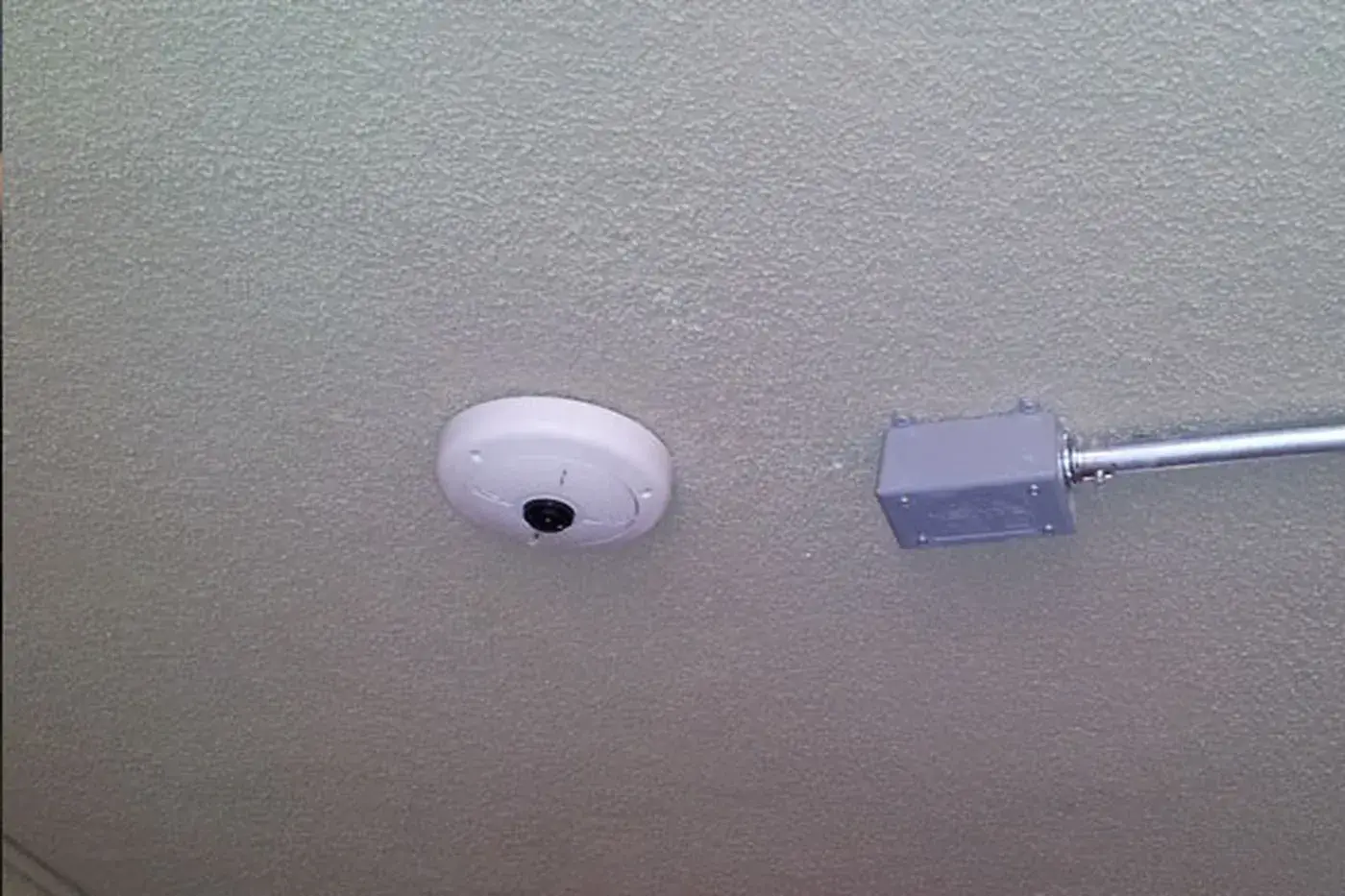
This is one of ours: a low-profile ceiling camera with its junction box and conduit drop beside it. Nothing about the picture is remarkable, which is rather the point. A wide overhead position is the sort of thing that gets specified because it looks efficient on a drawing, and it earns its place only if the thing you actually need to see is inside what it can resolve.
The containment matters as much as the camera. A single mount carrying one cable run is a real advantage of both wide camera types, and it is a smaller advantage than it looks if the position then needs a second camera beside it to do the job the wide one could not.
The other half
What does this position have to prove?
Every camera on a properly designed system exists to answer a specific question, and the useful ones sort into three kinds. Some positions have to establish that something happened: a door opened, a vehicle entered, somebody crossed a space. Some have to establishwhat happened in sequence: where a person went, what they were carrying, how long they were there. And some have to establishwho, which is a much harder requirement and the one that most often goes unmet.
A wide camera is genuinely good at the first two. A single overhead position can carry an entire floor’s worth of movement and let you follow somebody across it, which is exactly the account an investigation needs and exactly what four narrow cameras give you badly because the person keeps leaving one frame and entering another.
It is the third requirement where wide positions disappoint people, and they disappoint them after the fact, not at installation. A camera spreading its capability across a whole floor gives the doorway at the far end a share of that. The footage exists, the incident is on it, and the face is not usable. Nobody discovers this until the day it matters.
So the design that actually works is usually not a choice between the two types at all. It is a wide camera doing the account of the space, and a dedicated view on each point where identification is genuinely required, aimed and lit for that job. The wide camera reduces the number of cameras you need. It does not reduce it to one.
Where each earns its place
Six situations, and which way they push
Not rules. These are the considerations that actually move the decision when we are standing in the space.
A single open space with one obvious centre
Pushes toward fisheye. One mount, one cable, one continuous picture with no seams, and the ability to go back into a recording and look somewhere nobody thought to look at the time.
A corner, a T-junction or an L-shaped area
Pushes toward multi-sensor. Heads can be aimed down each leg independently, which is coverage shaped to the building instead of coverage shaped to the lens.
Racking, partitions or anything that gets rearranged
Pushes toward aimed heads, but cautiously. Anything that changes when the layout changes is a reason to be careful with any single position, and a plan drawn on an empty floor plate looks covered and is not.
The important activity happens at defined points
Pushes toward wide-for-context plus dedicated views on those points. This is the commonest real answer and it is the one that gets talked out of the design on cost.
Strong light behind the subject
Affects both and is a reason to be sceptical of any single position. A dock door or a glazed entrance backlights whoever is standing in it, and no amount of coverage width fixes a silhouette.
Getting back up there will be difficult
Pushes toward whichever choice needs revisiting least. A position that requires a lift to reach is one you want to be right the first time, which is an argument for deciding it standing under it, not from a drawing.
What this page refuses to give you
No numbers, and that is deliberate
There are no megapixel figures on this page, no field-of-view angles in degrees, no coverage areas in square feet, no ceiling heights, and no identification thresholds expressed as pixels across a face. That is not an oversight and it is not us being cagey.
Every one of those figures is a property of a specific product at a specific setting in a specific room. Quoted generically they are worse than useless, because they are precise enough to be believed and not tied to anything you are actually buying. This site does not publish a capability figure it has not verified for the product in question, and a camera-selection article is exactly where that rule earns its keep.
We are also not going to tell you that one wide camera replaces a specific number of conventional ones. That claim appears on almost every product page for both types and it is a marketing arithmetic instead of a design finding. How many cameras a space needs is answered by walking it.
What we will do at survey is show you what a proposed position actually takes in, and tell you plainly where a wide camera will not do the job you are hoping it will do. That is a more useful conversation than a specification comparison, and it is the only one that ends with a system that works.
Where this sits
One decision inside a design
Camera type is chosen after the positions and their jobs are settled, not before. The survey establishes what each view has to achieve in the light it actually has, and the device follows from that. The whole method is set out under commercial camera installation.
Two things frequently get bundled into this decision and should not be. Whether the system notices anything on its own is a separate capability under video analytics, and a wide camera does not acquire it by being wide. And the choice affects how much the system writes, which feeds straight into how far back it records — see how long security cameras keep footage. Large open spaces are where all of this comes together at once, which is covered for that building type under warehouse and logistics security.
Two boundaries, as on every page here. We work on commercial premises only and not on private residences. And we do not hold a C-10 or a C-16, so we do not work on fire alarm systems; that is coordinated with your own licensed fire alarm contractor.
common questions
Camera selection questions
Can one wide camera really replace several ordinary ones?
Sometimes, and the honest answer depends on what the position has to prove, not on how much of the room appears in the picture. Both fisheye and multi-sensor cameras genuinely cover a lot of space from one point, and where the job is to show what happened and roughly where, one of them frequently does replace several conventional cameras and reduces the cabling at the same time. Where the job is to identify a particular person at a particular point, a wide view spreads its detail across everything it can see, and the specific thing you needed to see clearly gets a share of that rather than a camera of its own. We would rather put a dedicated view on the position that has to identify somebody and use the wide camera for the context around it than pretend one device does both jobs equally.
What is the practical difference between the two types?
A fisheye is a single sensor behind a very wide lens, producing one continuous circular image that software then straightens into usable views. A multi-sensor camera is several separate camera heads in one housing on one mount, each looking at its own part of the scene, and their images sit side by side instead of forming one image. The practical consequences follow from that. A fisheye gives you one unbroken picture with no seams and no aiming decisions, but every part of the scene gets whatever the single sensor can give it. A multi-sensor lets each head be aimed at something specific, which means the coverage can be shaped to the room, but somebody has to make those aiming decisions and they are made at installation.
Which one is better for a warehouse or a large open floor?
Neither by default, and this is exactly the question we will not answer from a floor plan alone. What decides it is what the space is for. A large floor that needs a general account of movement, with the specific things that matter happening at defined points such as doors and dock positions, usually wants wide cameras for the floor and dedicated views on those points. A space where the important activity can happen anywhere across the whole area is a harder problem, and the answer is more often several aimed views than one very wide one. Height, obstructions, racking that moves when the layout changes, and where the light comes from all feed into it. That is settled at survey, standing in the space, which is the only place it can honestly be settled.
Do wide-angle cameras create a privacy problem in a workplace?
They make an existing question harder to avoid — they do not create a new one. A wide camera sees whatever is in front of it, so a position chosen for a work area may also take in a break area, a desk, or a doorway into somewhere cameras should not point. Our position on the boundaries themselves is fixed instead of negotiable: no camera covers the interior of a restroom, a changing area or a fitting room, and we will decline the request if it is made. Beyond those, where a camera can point on your premises is a question for your own counsel and your own employment obligations, and we design to what they tell you. What we can do at survey is show you exactly what a proposed position would take in before it is installed, so the decision is made with the picture in hand, not after it.
Related services
More from the install side
Retention
How long do security cameras keep footage?
Why there is no standard retention period, the one case in California where the law does fix one, and the four things that actually decide how many days your recorder holds.
Interoperability
What ONVIF does and does not guarantee
ONVIF conformance is a promise between products conformant to the same named profile. “ONVIF compatible” on a datasheet is a different claim, and the gap between them is where mixed-brand systems come apart.
Power and cabling
The PoE power budget, and why it bites when you add cameras
Power over Ethernet is the reason a four-camera addition to a working system sometimes needs a new switch. What the power budget is, why it is settled at survey, and why this page publishes no wattage figures.